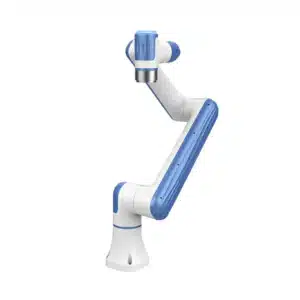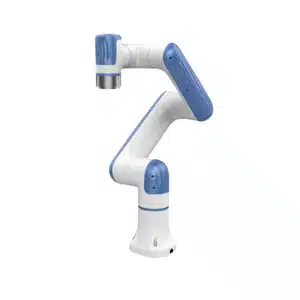

CR3A

Dobot develops user-friendly robotic arms for education, automation, and research, enabling precision, efficiency, and innovation in diverse industries worldwide.
The Dobot CR3A collaborative robot is designed for precision automation applications including assembly, pick-and-place, laboratory automation, and desktop manufacturing. Its compact footprint and lightweight design make it ideal for workstations where space is limited but accuracy and repeatability are critical.
Built for safe human-robot collaboration, the CR3A works alongside operators without complex safety fencing in many applications. As a result, manufacturers, educators, and research teams can automate repetitive tasks while improving consistency and workflow efficiency.
Key Features & Specifications:
• Reach – 620 mm / 24.4 in
• Payload – 3 kg / 6.6 lbs
• 6-axis collaborative robot design
• Compact footprint for desktop and small workspace integration
• User-friendly programming and fast deployment
• Integrated safety features for collaborative applications
• Smooth, precise motion for delicate handling tasks
• Ideal for assembly, testing, inspection, and lab automation
• Flexible mounting options for different workstation layouts
• Compatible with a wide range of end-of-arm tooling and accessories
When evaluating a compact collaborative robot solution, In-Position Technologies engineers take a consultative approach. First, they assess the application requirements. This helps determine the best cobot configuration for the project. Then, they evaluate system performance to ensure reliable and efficient operation.
Their evaluations include:
• Required throughput and cycle time targets
• Payload and reach requirements
• Workspace and workstation considerations
• End-of-arm tooling and application setup
• Accuracy and repeatability requirements
When customers deploy the Dobot CR3A as part of a complete automation solution, IP Tech’s engineers ensure the system is fully optimized by:
• Including all required components for a complete solution
• Verifying compatibility across cobots, tooling, and peripherals
• Confirming performance meets application requirements
• Supporting integration with vision, inspection, and automation systems